13 Principles of Effortless Motion
No. 5 – The ability to perform under pressure is best achieved by quietening the internal dialogue and controlling the body-chemistry; thus activating the ‘relaxation response’ and preventing the breakdown of technique.
Last week I presented a one-day seminar to a group of professional athletes and coaches from different parts of the UK. The purpose of the session was to show the delegates (through experiential learning) the relationship between the mind~body connection and effortless movement
One of the interesting things about working with a group of professionals is the fact that they, like you perhaps, can struggle to perform their best under the pressure of competition. This phenomenon is as common to the Olympian as it is to the juniour athlete at a local club event and solving this riddle has been my life’s work.
Many of the stories I heard during the seminar were about feelings of nervousness, anxiety and mental interference which began in some cases, weeks before the actual event and all but ruined the ability to perform at a high level, play according to potential and win in competitive situations.
This in turn contributed to a loss of confidence and a descending spiral of self-belief and ability.
Conversely when the delegates began speaking about their experiences of the zone or flow, I wasn’t at all surprised to hear what I’ve heard from hundreds of my students – that when preparing to compete, particularly in the moments of stillness before actual movement begins, if the attention can be gathered without activating the mind, specifically through focusing on breathing in a way that supports relaxation, they could move with freedom and fluidity even under pressure.
However, the mainstream approach to performance enhancement still advocates that in order to regroup when your game has fallen apart, you simply need to think positively and review your technique, overly practising the skills that have let you down – but you’ll know from experience that this doesn’t always prove to be beneficial and when it fails to help you move in a way that is purposeful yet effortless the next time you’re in contention, confidence vanishes, the mind gets busy and your performance deteriorates.
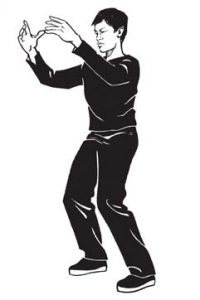
As the seminar progressed and we looked at various ‘deep practises’ from the Chi-Performance methodology, practises like seated meditation (Zen), standing practice (I Ch’uan – pictured right), postural training (Chi Kung) slow motions drills and biomechanical principles from Tai Chi it became apparent that the secret of effortless motion does not lie in technical know-how or positive self-talk alone but with something much more integral and profound – that is, the ability to be disciplined enough to bring your attention to your breathing rather than it getting hijacked by mental interference and feelings of anxiety.
This in turn activates the meditative state (aka ‘the zone’) which can then be applied to all aspects of your performance, from your preparation leading up to the tournament and competing in the actual event.