“Technique is a trap; style is a prison. Kung-fu is meant to liberate”.
Wong Jack Man
In my new book Connected Golf we’re re-looking at the mainstream assumptions upon which coaches are expected to teach and players are expected to perform; many of these will be turned upside down in our continuing exploration to discover the truth of the effortless golf shot, upon which foundation the whole game turns.
As we’re learning, a different perspective is useful and perhaps needed, now more than ever, and I hope what’s offered here can be considered categorical, based as it is on over three decades of training and teaching centuries-old disciples of the mind-body connection.
From this vantage-point we’ve seen the following.
Controlling the biochemistry takes precedence over psychology and positive thinking. It doesn’t necessarily replace it, all things have their designated role, but it certainly takes precedence during play. The brain-body chemistry triggers the stress-response and all ensuing forms of self-interference like over-thinking and trying too hard, which manifests in a poor shot. The result of this biochemical response is the breakdown of fluid movement, but the origins are in the nervous-system and not in the realm of the mind; the mind simply follows and creates coherence with the feelings of anxiety. This is a very important distinction.
There are certain fundamental principles which are related to movement and take precedence over technique. Again, they don’t replace it but they are imperative and override trends and fads that come and go. We’ll be exploring these throughout the book but simply put, they can be divided into two pillars.
The first pillar is awareness of breathing, which helps to lessen feelings of anxiety and reduce unnecessary thinking. This was explored in my previous book Breathe Golf.
The second pillar is the foundations of natural movement which we’re now examining and applying specifically to golf. These have been discovered, refined and honed by successive generations of martial arts families and schools, for instance those of various Tai Chi lineages, all working according to the same principles. These will form our benchmark for further exploration in Section Two.
Compare this with the lack of consensus among golf teaching professionals as to the core components of the swing; for instance how the take-away begins, and where the transition is initiated from, whether it’s a one plane or two plane movement let alone what constitutes what might be termed the classic or modern versions. Add to this, the fact that there are so many different examples of the golf swing on the elite tour today, and it becomes hard to see any underlying principles at all.
I can’t help but think about the parable of the blind men and the elephant! This ancient story attributed to Buddhist and Hindu texts tells us about a group of blind men who heard that a strange animal, called an elephant, had been brought to the town, although none of them knew anything about it. Out of curiosity, they decided to inspect it using the sense of touch as looking at the elephant to determine its shape and form was denied to them. So, they sought it out, and when they found it they started moving their hands around the elephant’s large mass. The first, whose hand landed on the trunk, said, “This animal resembles a huge snake”, and the second, whose hand reached its ear, said it seemed the elephant was like a fan that could be used to ward off flies and keep cool. As for the third person, whose hand was upon its leg, it seemed the elephant was a pillar similar to a tree-trunk. The blind man who placed his hand upon its side said the elephant “is a wall”, and yet another who felt its tail, described it as a rope. The last felt its tusk, stating the elephant was smooth and shaped like a spear. As none of the blind men could agree on exactly what the elephant was, the exploration turned into a fierce argument with none of them trusting what the other ones said.
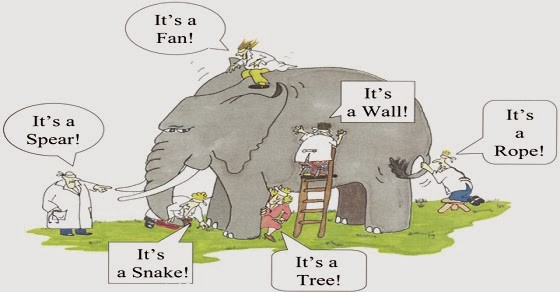
What this story illustrates is that subjective realizations are only true in part and that a bigger, more objective reality is often hidden from our limited perceptions.
In golf, there are so many contradictory theories and opinions but we’ll see that certain laws regarding complex movement remain timeless and further, that they apply to all sports.
When we apply them to golf, you learn to train the mind and body in specific ways, so they can join together to release a more natural, consistent and repeatable swing.
Understanding this offers a bigger picture that can help to dispel much of the current disagreement in the industry and give some definite parameters within which individual teaching styles and methods can flourish.
A common factor among many of the top swing coaches is the way they actively promote the idea that they have sole possession of the secret to better golf; a secret which they’re prepared to pass on to high-paying clients. These coaches rarely share their methods with their fellow coaches and in fact, rubbish the ideas posited by others in the same profession.
This creates ongoing disagreement about what constitutes the ideal swing and is as confusing to the elite player as it is to the committed amateur.
While there are lots of great and innovative theories, when you look at the key causes of effortless movement, many coaches with a specific insight into the swing or impact position, expand their particular idea to such a point of detail and analysis that it consequently can do more harm than good.
The swing is always deconstructed and interpreted from the point of view of what was wrong with it, without acknowledging that the many and varied faults which show up in motion are already in place at the set-up. A coach may understand something about the similarities of certain movements, for instance how a golf swing is similar to driving a nail with a hammer, but only when we engage the balance point, as identified in the martial arts, can the body respond naturally and powerfully to the intention to strike at rather than swing at the ball.
When interpretations deviate from the accepted principles honed in the Eastern arts, the understanding of the key drivers that constitute the perfect swing get lost in translation. As with the parable of the blind men and the elephant, many of the world’s top swing coaches have a piece of the puzzle but not the whole picture.
This is nowhere more clearly demonstrated than in the desperate plight of the elite player who has lost form and changes their swing coach in an attempt to get back in the game.
When a player isn’t performing well, they will find another coach who offers a variation on movement positions or the swing shape, in the hopes of finding the cure, the key to fixing the fault or faults in their swing. Yet this is often nothing better than a different set of compensations, and while the new secret gleaned from the new coach might work on the practice range, the player may have limited success with it in their next tournament.
There’s a reason for this.
As we’re becoming all too aware, the secret to better golf does not lie in learning ever more about technique or even in changing one’s technique, but in the two-fold path of bringing the mind into closer harmony with the body and training the body in some very simple, yet fundamental skills, which will enhance the delivery of natural and instinctive movement, especially when it needs to withstand the onslaught of pressure.
The golf swing of the player who wants to find his or her groove again having lost it, would then be easier to fine tune and replicate once certain fundamentals are firmly understood and in place.