How and why this simple approach has helped me win at golf
Written by Erik A. – Oxford, UK, Student of Jayne Storey’s Chi-Performance GOLF
Introduction
I have come into golf after retirement from a career in science and medicine. I found the game immensely enjoyable, but also challenging and full of frustrations. The golf swing is a movement and must be learned like any other complicated movement, from riding a bicycle to driving a car. Once you have learned the skill, the movements become automatic and you don’t have to think about it; therefore hitting a golf ball 50 yards with a club should be as easy as throwing it by hand.
The problem is that golf is not as easy as that. Thinking and worrying about the outcome gets in the way. Muscles tighten, the head comes up and the ball is not struck cleanly. In fact, it is often “skulled”, or even be totally missed!
Also, it does not go in the intended direction and distance.
Taking lessons with a swing pro and practicing what you’ve been shown will improve the golfing skills. On the driving range, you can hit booming drives. On the practice green, you learn to chip and putt with increasing confidence. The problem is that these skills don’t seem to transfer to the golf course. There you find that the drives hardly make it to the Ladies tee or disappear into the gauze. The chips that were meant to bounce and end a foot from the pin, scurry across the green into a bunker on the other side!
Why is that? The answer must lie in the workings of the brain. In my academic work, I had come across the psychologist Mihaly Csikszentmihalyi, author of ‘Flow; The Psychology of Optimal Experience’. He wrote that humans are only truly happy if they have what he called Flow. Flow is the mental state associated with intense activity in artists, surgeons, musicians or athletes.
The characteristics of Flow are:
- Intense focus on the present.
- A sense of personal control.
- An intrinsically rewarding and enjoyable experience.
Perhaps Flow had the answer to my golf problems? I was therefore curious to explore the Tai Chi-based method offered by Jayne Storey because it had a link to Flow, especially the area of her work which equates correct breathing with ease of movement.
Tai Chi
In Tai Chi, you learn what is often called ‘meditation in motion’, a slow moving sequence which is accompanied by deep and rhythmic breathing. The breathing will give you the stillness of mind i.e. Flow required for a perfect, unencumbered movement whether a fist punch or kick or indeed as it turns out, a putting stroke.
The technique has been used for centuries by monks at the Shaolin Temple and amongst all practitioners of what Jayne calls the internal martial arts. The reader is referred to the recent book by Jayne Storey, called “Breathe Golf; The Missing Link to a Winning Performance” which covers in the greatest depth, this pioneering use of Tai Chi and breathing techniques for golf.
I have now used Jayne’s method for some time and found that it works for me. The breathing meditation was quite difficult at first, as my mind tends to be full of thoughts and ideas. However, if I persisted, after about five minutes, the thoughts calmed down and my mind became more still. I found it difficult to maintain but gradually learned to enjoy the mental state associated with the meditation. It’s similar to the feeling of relaxing into an immense soft chair without switching off completely and falling asleep!
It takes time and mental effort to do this on a regular basis. To sit down and do nothing except pay attention to my breathing was difficult for me. But I persisted and it paid off. I got used to it and after some time I learned to enjoy it. I am also winning match after match these days which has become a bit embarrassing as my friends can’t understand what’s happened to me and I’m keeping my training as a closely guarded secret!
In the Chi-GOLF method, (abbreviated from Chi-Performance GOLF) you relate traditional meditation to rhythmic abdominal breathing centred on the T’an Tien which is the middle of the body, inside the stomach about 2 cm below the navel.
You will use this approach, based on Tai Chi to cultivate the quiet mind and a relaxed but stable lower-body needed before every golf shot, whether a drive or critical putt.
Different Brain Centres
 The brain is a complicated clump of interconnected nerve cells. These are organised in clusters or brain centres, that have different roles. For instance, there are separate centres for moving a limb, for hearing, remembering, speaking and so on. Centres are quite specific. For instance, a Classics teacher suffered a small stroke and could not speak English anymore. However, he could chat to his wife in Latin!
For the understanding of how Chi-GOLF actually works, I found it helpful to divide the brain into six different areas: Thinking Brain (TB) – Motor Brain (MB) – Worry Brain (WB) – Calming Brain (CB) – Breathing Brain (BB) – Spinal Cord (SC)
The Thinking Brain analyses different options for the golf shot, decides which club to use and where the ball should land. It then orders the Motor Brain to execute the shot.
The Motor Brain has several golf shot programmes in its archives, most basically the Golf Swing. It will normally execute a Good Golf Swing effortlessly.
However, if disturbed by influences from the Worry Brain, it will activate an alternative sequence which leads to The Bad Golf Swing. Jayne calls this my ‘default’ swing, which shows up every time I start over-thinking and lose the connection to my breathing and physical centre.
The Worry Brain is a simplified name for The Prefrontal Cortex which Jayne discusses in her book. Its role is to constantly scan for risks, dangers and unsatisfactory outcomes. It is a dominant part of the brain and is important for our survival. However, it is bad for the Golf Swing.
The Calming Brain is also known as the Occipital Cortex. It will calm things down. In electrical recordings of the brain, it produces so called alpha waves when the mind is in the state of Flow (also called ‘the Zone.’) The Calming Brain is activated by breathing meditation, the very thing Jayne is teaching.
The Breathing Brain is fundamental. It is sensitive to oxygen and carbon dioxide and drives the muscles associated with breathing. If it is knocked out by a stroke, the patient needs an external respirator.
There are two types of breathing.
Firstly, there is the quick, shallow breathing which engages the chest muscles. This is activated in emergency situations; it’s the ‘Fight or Flight’ response which is disastrous for golf!
Secondly, the abdominal deep breathing which is associated with a calm state of mind. Ideal for golf!
The Spinal Cord is simply the channel for the nerve impulses to go from the brain, in the right sequence, to the various muscles involved in the Good Golf Swing or the Bad Golf Swing.
A fundamental aspect of Chi-GOLF is that the Breathing Brain is linked to the Calming Brain. By practicing abdominal breathing, it is possible to achieve the inner stillness which Jayne describes as the master of motion.
A Good Golf Shot
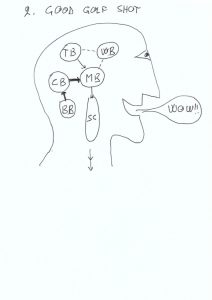 Fig 2 illustrates what happens in these brain centres during a good golf shot
The Thinking Brain decides what shot to make and instructs the Motor Brain to execute that shot. The right club will have been chosen and crucial Chi-GOLF procedures for executing the shot will have been used.
Crucially it will involve a number of deep abdominal breaths in connection with the body’s centre of gravity and various biomechanical principles from Tai Chi which are also employed.
This will activate the Calming Brain and get the golfers mind into the Flow state. This should not take more than 12 seconds. The only swing thought that I allow myself is perhaps an image of the planned shot.
My swing is then initiated by a small forward press and will then happen in an effortless way through pre-programmed events in the Motor Brain and the transportation of signals through the Spinal Cord out to the different muscles in the arms, legs and torso.
It only takes about 1.5 seconds to execute this complex motion. Suffice to say that when I relax into Jayne’s teachings the shot seems to happen all by itself; when I start thinking and analysing the shot always feels forced and the outcome is usually poor.
Throughout all the Chi-GOLF procedures, the Worry Brain is side-lined.
I endeavour to focus is on the procedure, not worry the outcome. A good shot is “anchored” by whispering” Wow”!
A Bad Golf Shot
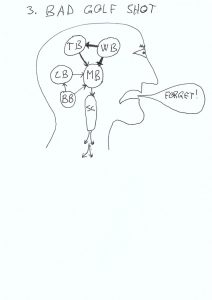 Fig 3 shows what happens in the brain during a bad golf shot.
The main difference is that the Motor Brain has lost the beneficial influence of the Calming Brain. Instead the Worry Brain has come to the fore with thoughts of adverse consequences. “I must carry the ball over this hazard!”, “I must not get into that bunker”, “I must get a par on this hole to win” are typical messages from the Worry Brain.
The consequence is that the normal sequence of signals in the Motor Brain is uncoupled, and an alternative sequence started which leads to a Bad (default) Golf Swing. This has little resemblance with the Good Swing. Typically for me, the head is raised and legs straightened, leading to poor ball contact. The body leans back rather than forward with loss of power. Most amateur golfers will have their own version of a “Bad Golf Swing”.
We all know the feeling of despair when this happens. It is important not to let these bad feelings linger. Try to erase the bad feelings so that you can start again. I whisper “Forget!” through my clenched teeth.
The Bad Golf Swing is pre-programmed in the Motor Brain, just as The Good Golf Swing is. They are the two separate swings, individually pre-programmed in the Motor Brain. You will either get one, or the other!
The main factor determining what swing you will get is the balance between the Worry Brain and the Calming Brain. If the Worry Brain dominates you will get the Bad Swing. If the Calming Brain dominates you will get the Good Swing.
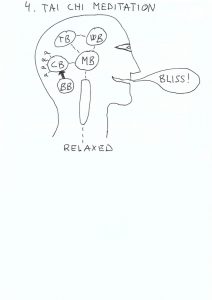 The unique feature of Chi-GOLF is that it provides a method to ACTIVATE the Calming Brain through deep breathing and therefore increases the chance of a Good Swing and reducing the chance of a Bad Swing.
It also offers many Tai Chi-based procedures for anchoring the breath to the body’s physical centre during play and for improving things like balance, stability, rhythm and rotation.
So what’s the catch? You need to practice breathing meditation and other simple drills from the method in order for this to be most effective.
Conclusions:
By practicing Chi-GOLF first hand with Jayne Storey, I have learned the following:
- Breathing meditation strengthens the Calming Brain.
- Tai Chi procedures help to link the Breathing Brain to the Calming Brain during golf play.
- Chi-GOLF is a workable method to attain stillness of mind before playing a golf shot.
- This stillness of mind is key to fluid motion and greatly increases the chance of a Good Golf Swing.
- Overall consistency of golf shots is improved with more enjoyment.
- The more regularly Chi-GOLF methods are practiced the better. Daily meditation and training is preferred, but three times weekly is also effective.
References:
- Csikszentmihalyi. “Flow, The Secret to Happiness”. TED talk.
- Jayne Storey. “Breathe Golf”. The Missing Link to a Winning Performance. (Panoma Press, April 2019)
To start winning more golf competitions, please enquire about 1-1 and online training with Jayne Storey – simply email jayne@chi-performance.com or text +44 7986 447 250