Many thanks to my student Martin D. for taking the time to share his experiences of working with me and applying the principles of my book Breathe GOLF over the 2019 golf season; hopefully it will be of benefit not only to other golfers looking to perform at their best but indeed to any athlete seeking ‘performance gains’ for those high pressure moments in competition.
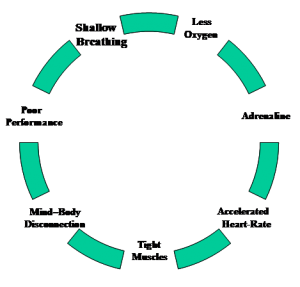
Here are some reflections on my experience of the Circle of Deterioration and the Circle of Excellence as detailed in Jayne’s book Breathe GOLF.
I believe that the first step for Jayne’s students is to become aware of the Circle of Deterioration while it is happening. We are all very familiar with it. We have our own names for it, and/or casual ways of accepting its inevitability, looking back from the safe distance the 19th hole. But are we really aware of what’s just happened? Jayne’s teaching about brain chemistry and biomechanics brings new meaning and insight into the experience, and a way forward.
In Breathe GOLF Jayne describes the two circles. Just after describing the Circle of Deterioration, she writes: “Now here’s what happens when you take control of your breathing.” This is an abrupt transition. If you are a person for whom, like me, the Circle of Deterioration has for many years been the default experience of a round of golf, the problem is getting to this “now” when you take control. But the solution is there if you read carefully. It’s useful for me, and hopefully for others, to describe what happens in detail, and pick out some helpful points in Jayne’s book.
For me, the Circle of Deterioration usually starts with awkward social situations. Some examples from this season include: being assigned the final pairing in an inter-club match play, waiting on the practice green for an eternity; waiting in the clubhouse of a premier course, not knowing whether I was going to get to play or not, and finally having to rush to the first tee and hit my opening drive while a small crowd watched impatiently; being called through by a noisy four-ball in the middle of a peaceful round. Suddenly I am nervous and uncomfortable. I am already descending into the circle, even though I manage to hit the fairway with my driver. But my next shot is misjudged, my chip powered over the back of the green, my return chip short, and two more putts. It’s a familiar story which continues for a number of holes or even the rest of the round.
With Jayne as your teacher, you know you need to work through this, return to your breath, breathe deeply, widen your vision, and keep breathing deeply. Finally, half way through the back nine you might birdie a par five, get a little run of pars going, but it’s often too little too late. What’s actually happened out there? How can you make the transition from the Circle of Deterioration to the Circle of Excellence? Here are my observations.
 Possibly the biggest problem facing someone learning Jayne’s ‘deep practice approach’ is that when one is descending in a spiral of deterioration, the first thing that goes is the awareness of the descent. Using the words “tension” and “anxiety” don’t seem to capture the descent for me. It is a state of very heightened, but debilitating, awareness. It is an awareness that is frantically faced outward: an awareness of what others are doing and thinking (playing partners, onlookers, or a psychological “Big Other” or Superego, to borrow terms from psychoanalysis), an awareness of what the hands and arms and club have to do for the next shot, an awareness of what another outcome like the last one will do to the scorecard.
So much awareness! Even for someone who is practising her teaching, this state of being can go on for hole after hole before you can even observe it from the position of your calmer, practised, breathing self. It seems that for the learner, the round has to look like a complete hopeless disaster before you realise you are in the grip of the Circle of Deterioration.
Along the way you hit some good shots. This might feel like a way out, but it is not. All golfers have had the experience of hitting a shot as beautiful as Jack or Tiger. Jayne calls this “the accidental experience of spontaneous excellence.” (pp 31) For middle to low handicappers, this will probably happen two or three times a round, from a drive that is as good as your best, a pitch that bounces right up to the pin, or a tricky putt that curves beautifully into the hole. If you are not aware that you’re on the verge of or even descending into the Circle of Deterioration, a shot like this can often be the worst thing that can happen to you. You will think: “It’s OK, I’m fine. I can do this. Keep trying.” So you go back to the default states of thinking about your technique and trying too hard to make good shots happen. But nothing in your breathing changes and nothing in your body changes, and the chance of an effortful disaster on the next hole increases.
So you have managed a decent drive or holed a putt, and you are still deteriorating. Somehow you finally wake up to the situation, but your body is in such a state that it is very difficult to judge the quality of your breathing. Indeed, one of those full but shallow breaths that sometimes unconsciously occur when you are panicked might trigger your awareness. But you are deep in hyper-monkey-mind-mode, so the first thing that happens is you start thinking about the Circle of Deterioration, and thinking about the Circle of Excellence. There is a deep drive to think your way out of it. “Must breathe deeply!” barks the inner director. And you try. But what does a deep quality breath feel like? Is this breath I am breathing right now deep or shallow? You cannot give yourself a confident answer. Another hole, another bogey, and you are still trying to think your way out, only now you are thinking about your breathing. This might not even be progress.
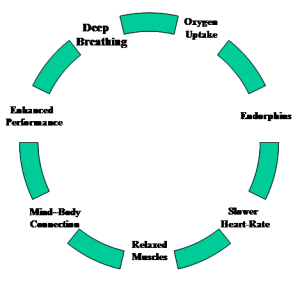
How to make this transition from the Circle of Deterioration to the Circle of Excellence? In my more recent rounds, I have been better at staying alert and aware of my morning breathing-meditation practice before and during play. It takes stamina and vigilance to start off with it and keep the Circle of Excellence flowing throughout the round, no matter the situation, just as it does to stay with your breath when meditating. But to pull yourself out of the depths of the Circle of Deterioration, if for whatever reason you find yourself there, is another level of difficulty altogether.
This is what I have learned about that task so far:
- Remember to remember. It is not enough to remember Jayne’s teaching. Remembering is just thinking, and it will not bring you out of the Circle of Deterioration. You need to remember to remember your breathing. This passage from Breathe Golf about the connection between daily meditation practice and golf performance is crucial:
“You will begin to notice when you forget all about your body and your breathing and become stuck in your mind. . . Noticing when you are out of sync, over-thinking, rushing, gripping the putter too tightly, feeling anxious on the tee and so on, will act as a reminder to follow your breath and help you get back into the flow before taking the shot. Seeing how often you forget to remember your breathing is also priceless training.” (pp 35, my emphasis).
- Remember to focus on the t’an tien, not the breath. Jayne has put this in italics in her book:
“You must ensure that your attention is on the navel area/t’an tien to encourage the breath to deepen; attempting to do these exercises with shallow breathing . . . will have the opposite effect to that desired.” (pp 86, my emphasis)
She also says to remember “not to try and take deep breaths as this is counterproductive, but just keep your awareness of the lower abdomen/t’an tien which will encourage the breath to deepen and slow down.” pp 83
This is the key to making the transition out of the Circle of Deterioration.
- Make good use of the accidental good shot.
One is executed in a state of tension, analysis, and worry. This near enemy can fool you into thinking that your body and mind can handle what is ahead. An effortful shot that flies nicely and/or hits the target is comforting. Ask the question: is the quality of my breathing as good as that shot? Turn this moment of comfort, beauty and enjoyment into an opportunity to break the cycle and come back to the right awareness. Soak it in, widen your perspective, and come back to your t’an tien.
The other one is effortless. An effortless shot is the true good shot, even if it misses the target. You have missed the target, but you know you are in the Circle of Excellence. It is the swing feeling, not where the ball ends up, that tells you whether you are in the Circle of Excellence.
Let every good shot, whether an effortful accident or an effortless miracle, be a trigger to step away from thinking.
- Be patient, gentle, and compassionate with yourself. You must wait for your awareness to return, and trust that it will return. As Michael Murphy wrote in Golf in the Kingdom of his first taste of “true gravity” golf with the guru Shivas Irons:
“I could only sustain it for a while. On the twelfth hole . . . familiar images of disaster began to haunt me as I took my stance. I sliced the drive and the sea breeze carried the ball into the rough. Shivas walked along beside me up the fairway, and asked me what I was thinking. I told him about the awful thoughts. “They’ll pass, if ye daena’ fight ‘em. Come back to where’er you were a minute ago. Wait ‘em oot.” These words were a great help—not only for the rest of the round but for my life ever since. The admonition to “wait ‘em oot” was one of those sayings of his that came back to haunt me.” pp 31.
I think that is the best passage in this weird and wonderful book.
- Bring competitive pressure into your practice. I am beginning to see the importance of “introducing distractions” into my breathing-meditation practice (Breathe Golf pp 59); and I am beginning to feel more clearly the connection between sticking to my daily meditation as Jayne advises, and the ability to come out of the Circle of Deterioration on the course. I have even tried a bout of intentional shallow breathing, to create the very condition I want to prevent, get to know it better, and practice coming out of it.

- It will take time to make the transition. It may take an entire round, months or an entire season to develop the ability to remember to remember, to be aware of shallow breathing and over-thinking, and to judge shots by their effortlessness not their outcome. Keep putting yourself into pressure situations so you can observe what happens. Early this season Tiger Woods won a 5th Masters trophy. It has taken him nine years to come from the depths of deterioration back to the pinnacle of excellence and part of this success is due to his return to his Mother’s religion of Thai Buddhism and daily meditation.
My experiences this season have taught me that the Circle of Deterioration does not just disappear by itself. But with dedication, the time you spend inside it can be pared back. By training your awareness and your vigilance with breathing-meditation practice, you can detect that a shot was bad because your mind was too effortful or too distracted; and where it once might have taken you the rest of the round to bring yourself back to your breathing, now you can get there with the dozen or so deep breaths you take before addressing the ball again.
This is the definition of progress for me. Lower scores and a drop in handicap have followed, and more competition wins. However, even more exciting is the feeling that I could be a better golfer than I have ever allowed myself to imagine.
Martin D. Ireland – Student of Jayne Storey’s Breathe GOLF training.

To learn more about the Circle of Excellence and Circle of Deterioration please refer to Jayne’s bestselling book ‘Breathe GOLF; The Missing Link to a Winning Performance’ – paperback, audio and Kindle versions are available from Amazon UK and Amazon US
1-1 Breathe GOLF training is available with Jayne in Berkshire/Hampshire and over Skype. For more details on bookings for 2020 please get in touch using the Contact form or the email/mobile at the top left of the Homepage.
Happy training!